Choosing an Entity Type: A Full Comparison Guide
Starting a business means making one decision that shapes almost everything else, your taxes, your legal liability, your paperwork, and even how easily you can raise money later. That decision is your entity type. This entity type comparison guide breaks down every major business structure side by side, so you can compare them at a glance and choose the one that actually fits your situation, not just the one that sounds familiar. Choosing the best entity for your situation is critical for your success.
What Is a Business Entity Type?
A business entity type is the legal structure under which your company operates. It determines:
- Who is personally liable for business the acts and debts of the business
- How the business is taxed
- What paperwork and formalities are required
- How ownership and profits are divided
- How easy it is to raise capital or bring on partners
Choosing the wrong structure early on can be expensive to fix later, so it’s worth understanding your options before you file anything.
The Main Business Entity Types
Sole Proprietorship
A sole proprietorship is the default structure for a single-owner business with no formal registration. There’s no legal separation between you and the business.
Pros:
- Easiest and cheapest to start
- Minimal paperwork
- Full control over decisions
Cons:
- No personal liability protection
- Harder to raise funding
- Business income is taxed as personal income
Partnership
A partnership involves two or more people sharing ownership. Common types include general partnerships (GP), limited partnerships (LP) and limited liability partnership (LLP), which is the most common business type for large law firms.
Pros:
- Simple to form
- Shared resources and responsibilities
- Pass-through taxation
Cons:
- Partners are typically personally liable (in a GP)
- Potential for disputes over control or profit-sharing
- Business ends or must be restructured if a partner leaves
Limited Liability Company (LLC)
An LLC blends the liability protection of a corporation with the tax flexibility of a partnership. LLCs are a very common choice for most small closely held businesses.
Pros:
- Personal liability protection
- Flexible management structure
- Pass-through taxation by default (avoids double taxation)
- Fewer formalities than a corporation
Cons:
- Self-employment taxes can apply to profits
- Rules and fees vary by state
- Less attractive to venture capital investors than a C corp
S Corporation
An S corp isn’t a separate entity type on its own, it’s a tax election available to eligible LLCs or corporations.
Pros:
- Pass-through taxation (avoids corporate-level tax)
- Potential savings on self-employment taxes
- Liability protection (if structured as a corporation or LLC)
Cons:
- Ownership restrictions (limited number of shareholders, U.S. citizens/residents only)
- Stricter operational requirements (payroll, reasonable salary rules)
- Only one class of stock allowed
C Corporation
A C corp is a fully separate legal entity from its owners, taxed independently.
Pros:
- Strongest liability protection
- Easiest structure for raising venture capital
- No ownership restrictions or limits on shareholders
- Multiple stock classes allowed
Cons:
- Double taxation (corporate profits taxed, then dividends taxed again)
- More regulatory and reporting requirements
- More expensive and complex to maintain
Nonprofit Corporation
Designed for organizations pursuing charitable, educational, religious, or similar missions rather than profit distribution to owners.
Pros:
- Eligible for tax-exempt status
- Access to grants and donations
- Liability protection for directors/officers
Cons:
- Profits can’t be distributed to owners
- Significant compliance and reporting requirements
- Formation and approval process can be lengthy
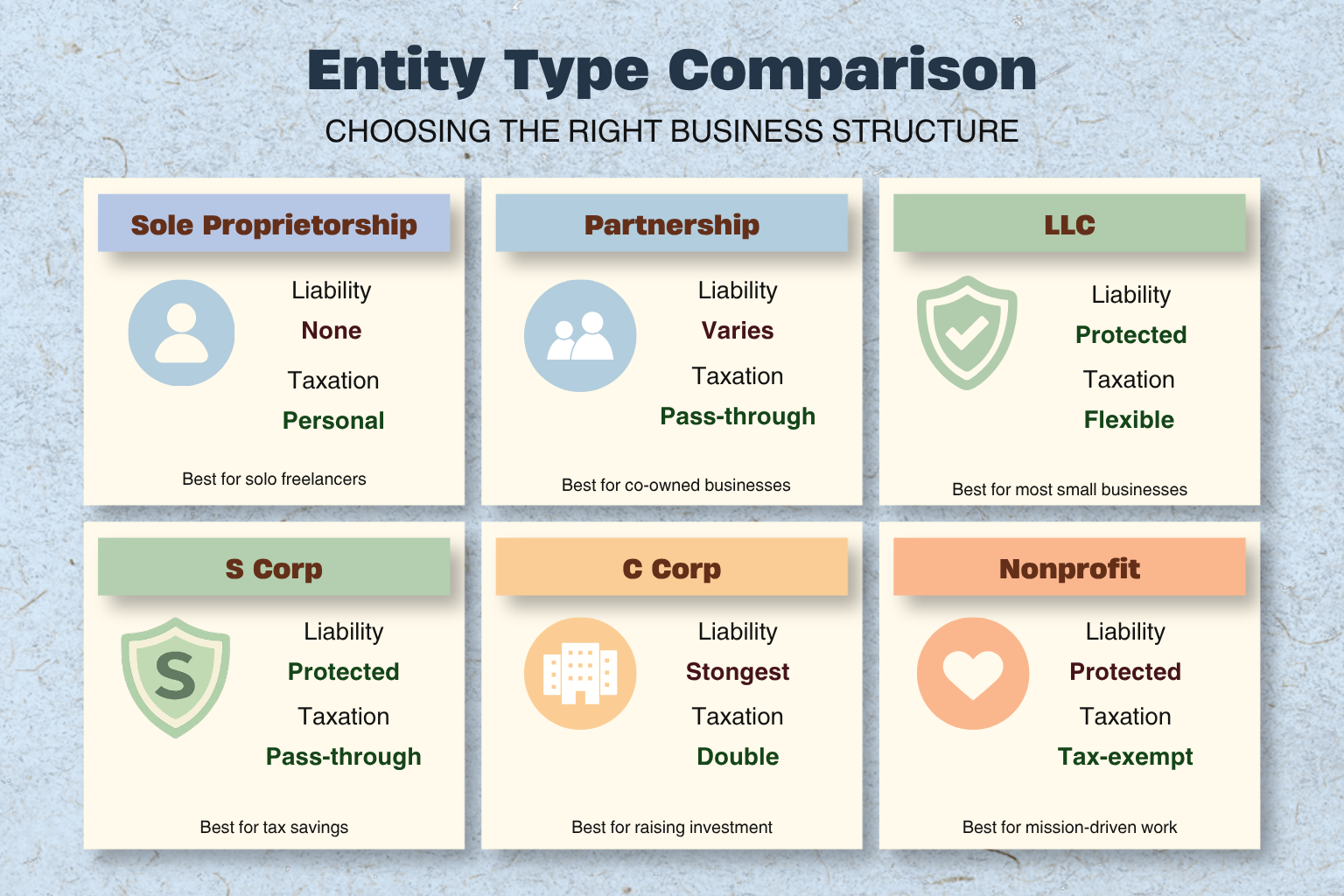
Entity Type Comparison at a Glance
| Entity Type | Liability Protection | Taxation | Best For |
| Sole Proprietorship | None | Personal income tax | Solo freelancers, low-risk side businesses |
| Partnership | Limited (varies by type) | Pass-through | Co-owned businesses with shared trust |
| LLC | Yes | Pass-through (flexible) | Most small to mid-size businesses |
| S Corp | Yes | Pass-through | Profitable small businesses seeking tax savings |
| C Corp | Yes | Double taxation | Startups seeking investors, larger companies |
| Nonprofit | Yes | Tax-exempt (if approved) | Mission-driven organizations |
Key Factors to Consider When Choosing an Entity Type
Liability Exposure
If your business carries any risk of lawsuits, debt, or claims, structures offering personal liability protection (LLC, S corp, C corp) are usually safer than a sole proprietorship or general partnership.
Tax Implications
Pass-through entities (LLC, S corp, partnership) avoid corporate-level tax, while C corps face double taxation but may offer advantages for reinvested profits and certain deductions.
Growth and Funding Plans
If you plan to raise venture capital or eventually go public, a C corp is typically the standard choice among investors.
Administrative Burden
Sole proprietorships and partnerships require minimal upkeep. Corporations require more recordkeeping, meetings, and filings.
State-Specific Rules
Entity requirements, fees, and taxes vary by state, so it’s worth checking local regulations or consulting a professional before filing.
How to Choose the Right Entity Type for Your Business
- Assess your risk level — how exposed is the business to liability?
- Estimate your tax situation — would pass-through taxation or corporate taxation benefit you more?
- Think about future funding — will you need outside investors?
- Consider administrative capacity — can you handle corporate formalities, or do you need something simpler?
- Consult a professional — a CPA or business attorney can confirm the right fit for your specific situation.
Frequently Asked Questions
Can I change my entity type later?
Yes. Many businesses start as a sole proprietorship or LLC and convert to a corporation later as they grow. The process varies by state and entity type.
Is an LLC always better than a sole proprietorship?
Not always — but the liability protection an LLC offers makes it the safer default for most businesses beyond a very low-risk side venture.
Do I need a lawyer to choose an entity type?
It’s not required, but, professional guidance is strongly recommended, especially if your business involves significant risk, multiple owners, or plans to raise capital.
Here’s The Bottom Line
There’s no single “best” entity type, only the best fit for your specific goals, risk tolerance, and growth plans. Comparing your options side by side, as outlined above, is the clearest way to make a confident, informed decision before you file your formation documents.